
&w=3840&q=75)
HSE Performance
HSE Performance
Valuing Safety
At Fluor, successfully managing health, safety and environmental (HSE) issues to the lowest possible risk levels is integral to the way we do business. We continue to be recognized as one of the safest contractors in the engineering and construction industry, and we thoroughly evaluate any incidents – including near misses – that occur to immediately identify areas for improvement.
We analyze both actual severity and potential severity, or “what could have happened,” in all HSE incidents to prevent recurrences and issue HSE alerts to promote learning throughout the organization.
Performance
A company-wide U.S. Occupational Safety and Health Administration (OSHA) standard guides our measurement and reporting process regardless of work location.
At Fluor, safety performance is measured not only by the outcomes we report, but by the actions we take every day to prevent incidents before they occur. While traditional lagging indicators such as incident rates remain an important benchmark, our strongest opportunities lie in leading indicators, the behaviors, systems and signals that show how effectively our safety programs are working in real time.
In 2025, our workforce reported a total of 324 recordable incidents; four of which resulted in life-altering injuries; and 42 of which had the potential to result in life-altering injuries, illnesses or fatalities. Additionally, there were 91 other incidents that threatened serious injury, fatality or damage in 2025. Serious lacerations and fractures were our most significant high-severity injuries in 2025. There were no fatalities in 2025.
Total case incident rate, self-perform and subcontractor
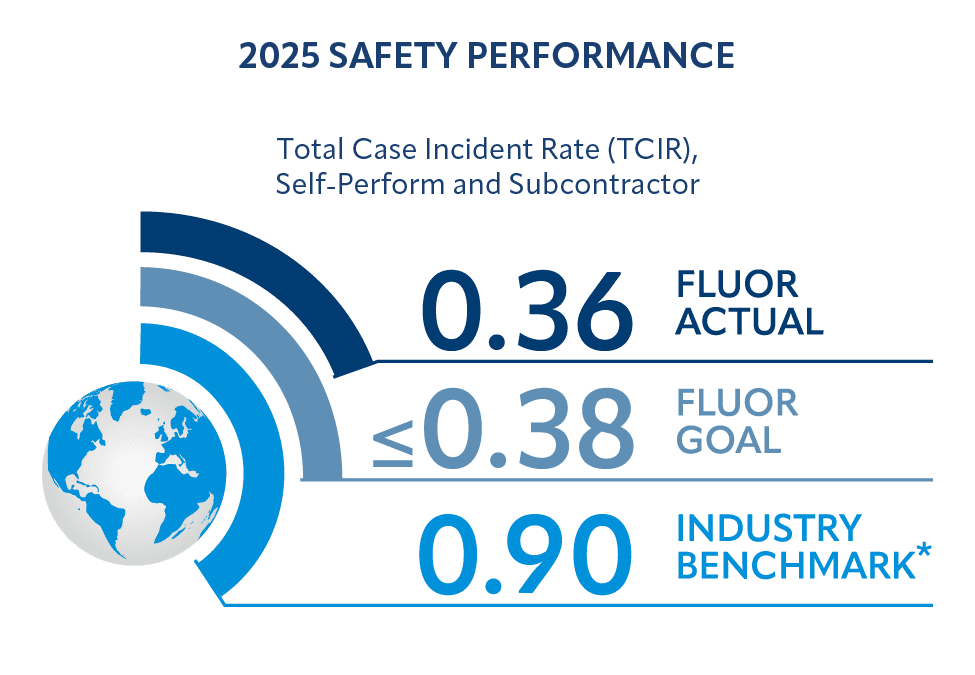
The self-perform and subcontractor work hours executed by our offices and in the field in 2025 resulted in a Total Case Incident Rate (TCIR) of 0.36 versus the industry average of 0.90 (U.S. Bureau of Labor Statistics data for construction companies with more than 1,000 employees).
Days away, restricted or transferred, self-perform and subcontractor
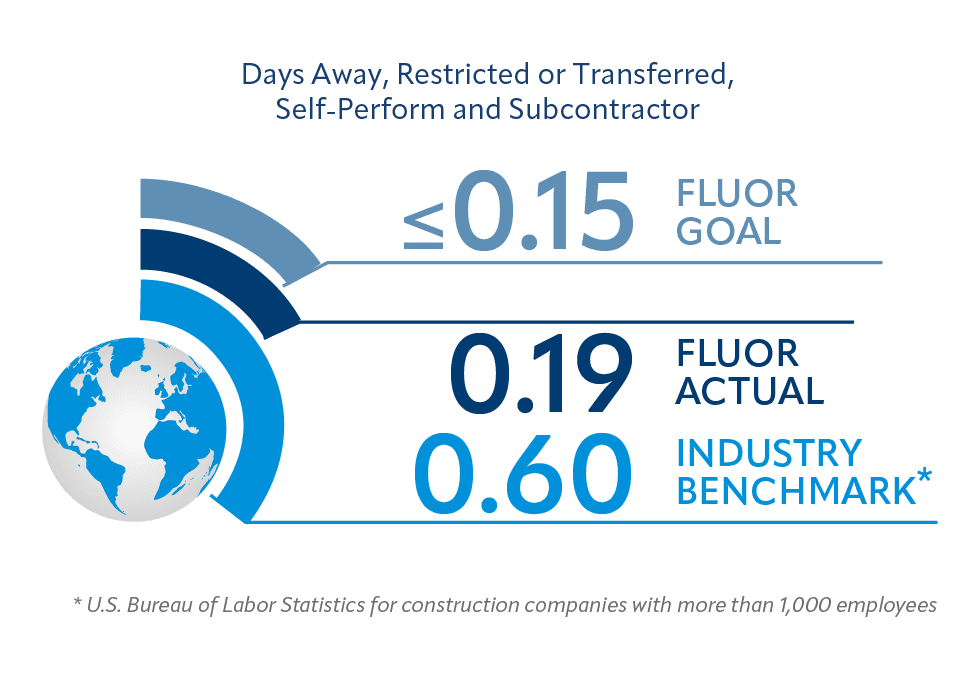
We had a combined 2025 Days Away, Restricted or Transferred (DART) workday case rate of 0.19 versus the industry average of 0.60 (U.S. Bureau of Labor Statistics data for construction companies with more than 1,000 employees).
Lost-time injury rate
In 2025, our lost time injury (LTI) frequency rate per 1 million hours worked was 0.59. Our LTI severity rate (number of days lost due to injuries multiplied by 1,000 per total hours worked) was 0.02.
Improvements Through Audits
Our HSE audit program allows leadership to measure site leading indicator performance and presents them with tangible opportunities to identify and prioritize areas for improvement.
In 2025, we completed a total of 78 corporate HSE audits. The 31 general worksite audits received an average score of 94.6%; the 21 Life Critical℠ audits received an average score of 91.8%; and the 26 office audits scored 94.0%, bettering our goal of 90%.